How to Prevent Low Blood Sugar While Running (What I’ve Learned After 13 Marathons with Type 1 Diabetes)
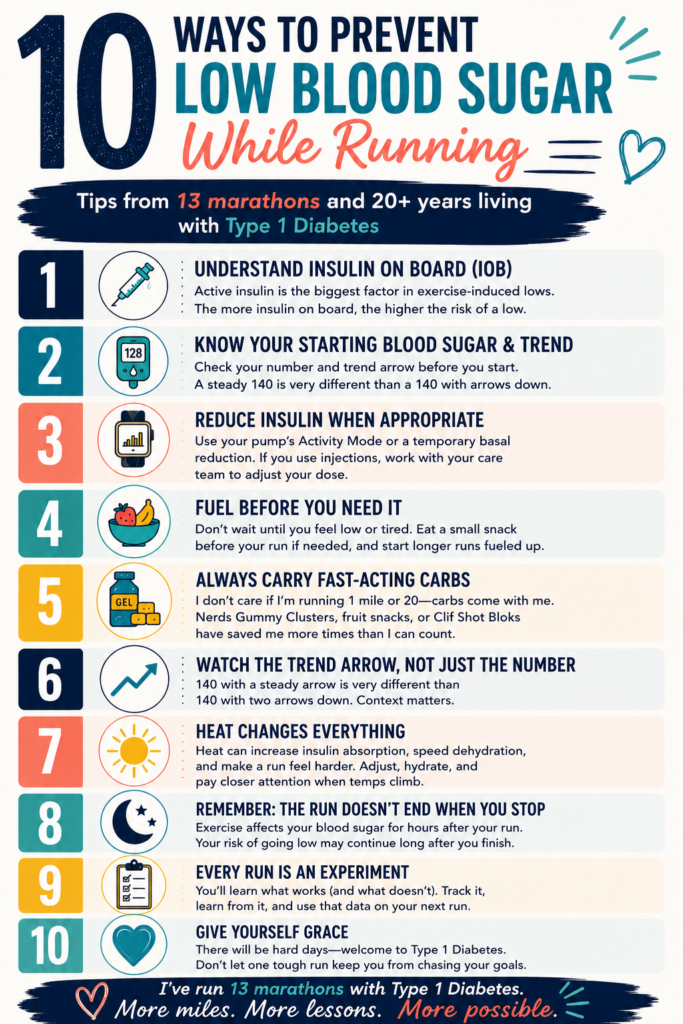
One of the biggest fears people have when they start running with Type 1 diabetes is going low.
I know because it was one of my biggest fears too.
When I was diagnosed with Type 1 diabetes in 2005, I honestly thought my running days might be over.
I had so many questions.
Would my blood sugar crash?
What if I passed out?
Was it even safe for someone with Type 1 diabetes to run?
Back then, there weren’t nearly as many resources—or runners openly talking about exercising with Type 1 diabetes. I felt like I was figuring everything out on my own.
For a while, I ran alone.
Not because I wanted to.
But because of the stigma I felt after my diagnosis. I wasn’t sure if people with Type 1 diabetes were “supposed” to run. I worried about going low. I worried about needing help. I worried that if something happened, people would think I shouldn’t have been running in the first place.
Ironically, even though I had always been a runner, running a marathon had been sitting on my bucket list for years. It was one of those dreams I always thought I’d get to someday, but life had a way of getting in the way.
Four years after my diagnosis, my husband and I moved across the state, and I stepped away from my career to become a stay-at-home mom. For the first time in a long time, I had the opportunity to chase a goal that had been waiting in the background.
So I signed up for a marathon.
Looking back, I don’t think I realized it then, but Type 1 diabetes changed why I ran.
Before my diagnosis, running was simply something I enjoyed.
After my diagnosis, running became something more.
Every training run proved that diabetes didn’t get to decide what I was capable of.
Every finish line became a reminder that I was stronger than I had once believed.
Running wasn’t just exercise anymore.
It gave my life with Type 1 diabetes purpose. It gave me confidence. It taught me resilience. And somewhere along the way, it became my way of showing myself—and hopefully others—that Type 1 diabetes doesn’t have to put your biggest dreams on hold.
Looking back now, after more than 20 years with Type 1 diabetes and 15 marathons, I wish I could tell that newly diagnosed version of myself one thing:
You absolutely can do this.
Running with Type 1 diabetes takes more planning than it does for most people, but it is absolutely possible.
The goal isn’t perfect blood sugars.
The goal is learning how your body responds.
Low blood sugars while running aren’t inevitable.
Can they happen? Absolutely.
But there are a lot of things you can do to stack the odds in your favor.
These are the strategies I’ve relied on through thousands of training miles and 13 marathons.
1. The Biggest Factor Isn’t Your Blood Sugar—It’s Your Insulin
This was one of the biggest mindset shifts for me.
For years, I thought my starting blood sugar was the most important number.
It matters.
But active insulin (also called insulin on board) matters even more.
Think about it.
If you have a lot of rapid-acting insulin still working when you start running, your muscles become even more efficient at pulling glucose from your bloodstream.
That’s a recipe for a low.
Whenever I’m getting ready for a run, one of the first questions I ask myself isn’t:
“What’s my blood sugar?”
It’s:
“How much insulin is still working?”
That single question has probably prevented more lows than anything else I’ve learned.
2. What If I’m Hungry Before My Run?
One of the questions I get asked the most is:
“What if I’m hungry before I run?”
My answer?
Eat.
Running on an empty stomach isn’t a requirement for avoiding low blood sugars, and if you’re hungry, your body is probably telling you it needs fuel.
The trick isn’t avoiding food.
It’s managing the insulin that comes with it.
If I’m eating before a run, I’m already thinking ahead.
- How soon am I heading out?
- How far am I planning to run?
- How intense will today’s run be?
- How much insulin will still be active when I start?
Many runners with Type 1 diabetes reduce their meal bolus before exercise to decrease the amount of active insulin they’ll have during their run. In general, the closer your run is to your meal—and the longer or more aerobic the workout—the greater the insulin reduction that may be needed. Finding the right adjustment takes trial and error and should always be discussed with your diabetes care team.
For me, I try to leave enough time after eating so that most of my rapid-acting insulin has already done its job before I head out. If I’m running sooner than usual, I’ll often reduce my meal bolus because I’d much rather start with less insulin on board than spend the first few miles chasing a low.
Over the years, I’ve learned that insulin on board is usually a much bigger predictor of whether I’ll go low than my starting blood sugar alone.
Remember: You don’t earn extra points for running on an empty stomach.
Fuel your body.
Just plan your insulin.
3. Start Every Run With a Plan
Every run starts before you lace up your shoes.
Before I head out, I ask myself:
- What is my blood sugar?
- Which direction is my CGM trending?
- When did I last eat?
- Do I still have insulin on board?
- How long am I planning to run?
- Is it especially hot today?
Those answers help me make decisions before I ever take my first step.
4. Use Your Pump’s Exercise Features
If you wear an insulin pump, learn every exercise feature it offers.
For me, Activity Mode has become one of my most valuable tools.
Reducing insulin delivery before exercise can make a huge difference.
Exactly how much and when to start depends on your body and your insulin regimen, so work with your diabetes care team to find the approach that fits you.
Personally, I typically reduce my insulin delivery about 90 minutes to two hours before my run.
5. Don’t Wait Until You’re Low to Eat
One of the biggest mistakes I see new runners make is waiting until they feel low.
By then, you’re already behind.
Instead, think about fueling proactively.
For shorter runs, that might mean having a small snack beforehand if needed.
For longer runs, it means fueling consistently before your body starts running out of energy.
Your goal is to stay ahead of the low—not chase it.
6. Always Carry Fast-Acting Carbohydrates
I don’t care if I’m running one mile or twenty.
I’m bringing carbohydrates.
Every.
Single.
Time.
For me, that usually includes:
- Nerds Gummy Clusters
- Fruit snacks
- Clif Shot Bloks
Hopefully they come home with me.
But if I need them, they’re there.
That peace of mind is worth carrying a few extra ounces.
7. Watch the Trend Arrow, Not Just the Number
A blood sugar of 140 mg/dL can mean two completely different things.
140 with a steady arrow?
Very different than…
140 with two arrows pointing down.
Your CGM trend arrow gives context.
It’s often just as important as the number itself.
8. Heat Changes Everything
If you’ve followed my training, you’ve probably heard me say this before.
Heat changes everything.
It can increase insulin absorption.
It can speed dehydration.
It can make a run feel much harder than the same pace on a cool morning.
When temperatures climb, I pay even closer attention to my blood sugar, hydration, and how I’m feeling.
Sometimes the smartest adjustment isn’t running harder.
It’s slowing down.
9. Remember That the Run Doesn’t End When You Stop
One of the biggest lessons Type 1 diabetes has taught me is that exercise doesn’t stop affecting your blood sugar the moment your watch says Finish.
Your muscles continue replacing glycogen stores for hours afterward.
That means your risk of going low may continue long after you’ve showered, eaten breakfast, or even gone to bed.
Some of my toughest lows haven’t happened during a run.
They’ve happened afterward.
Planning for recovery is just as important as planning for the run itself.
10. Every Run Is an Experiment
Even after 20 years with Type 1 diabetes, I still learn something almost every week.
Maybe I needed a little less insulin.
Maybe I should have fueled earlier.
Maybe the heat changed everything.
Maybe yesterday’s strength workout made me more insulin sensitive.
I don’t see those as failures.
I see them as data.
Every run teaches me something I can use on the next one.
Give Yourself Grace
There are days when you’ll do everything “right”…
…and your blood sugar will still surprise you.
Welcome to Type 1 diabetes.
Don’t let one difficult run convince you that running isn’t for you.
Every runner has challenging workouts.
Ours just come with a few extra variables.
My Biggest Takeaway
People often ask me how I’ve managed to run 13 marathons with Type 1 diabetes.
The answer isn’t that I’ve figured diabetes out.
It’s that I’ve learned to work with it.
I don’t expect perfection.
I expect to pay attention.
I expect to make adjustments.
I expect to learn.
That’s what has made me a better runner—and a more confident person living with Type 1 diabetes.
If you’re nervous about your first run after being diagnosed, know this:
You’re not alone.
Confidence doesn’t come from perfect blood sugars.
It comes from experience.
Every run teaches you something.
Every mile builds confidence.
And every lesson brings you one step closer to becoming the runner you want to be.
Important: Every person with Type 1 diabetes responds differently to exercise. The strategies in this article are based on my personal experience and should not replace medical advice. Work with your diabetes care team before making changes to your insulin, nutrition, or exercise plan.