5 Things I Refuse to Believe as a T1D Runner
This post contains affiliate links and I may earn commission on qualified sales.
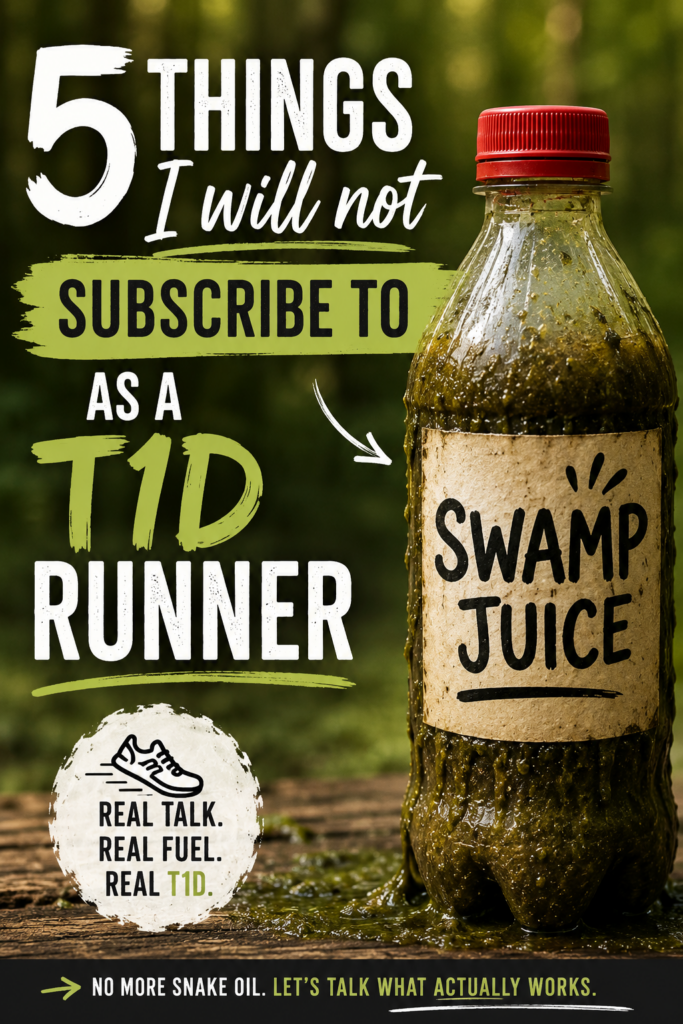
There is a lot of advice floating around for diabetic runners. Some of it is great. Some of it is well-meaning but wrong. And some of it is a guy on the internet trying to sell me something in a bottle that looks like it came out of a swamp.
After years of running with a CGM on my arm and an insulin pump on my body, I’ve developed a pretty firm list of things I’m just not doing. Not negotiating. Not reconsidering. Not subscribing to.
Here are five of them.
1. I will always run my basal reduction. Always.
No matter what my blood sugar is reading before a run, I reduce my basal 1.5 to 2 hours out. High? Still doing it. Borderline? Still doing it. Already feeling good? Especially still doing it.
I learned this the hard way. There is a specific kind of anger that comes from watching your blood sugar crash mid-run and having to bail on a workout you were actually looking forward to. It is not rational. It is not proportionate. And I will do basically anything to avoid it, including reducing my basal before every single run without exception.
This isn’t blanket advice for every T1D runner — your settings, your insulin, your body. But for me? Non-negotiable.
2. I will always carry fuel. Every run. No exceptions.
Do I need it every time? No. Do I bring it every time anyway? Yes.
I carry Clif Shot Bloks on every run. Every single one. The five-miler, the long run, the easy recovery jog where nothing is going to happen. Because “nothing is going to happen” is exactly what I thought the one time I had to make an emergency phone-a-friend call from the side of the road.
You only do that once.
For longer efforts I pre-fuel with UCAN before I head out the door. No sugar spike, no crash, steady energy that doesn’t send my CGM graph into chaos. Then I carry Shot Bloks for fast sugar if I need it mid-run. That combo — steady base fuel plus fast-acting backup — took me a long time to land on and I’m not messing with it.
I keep everything in my StashBandz running belt. Four pockets, sits flat, doesn’t bounce, and holds my phone, my Shot Bloks, my ID, and whatever else I’m hauling that day. For a T1D runner who is already carrying more than the average person, having a belt that actually organizes everything without adding bulk is not a small thing.
This post contains affiliate links. I only recommend products I actually use.
3. I will not be buying your swamp juice.
You know what I’m talking about. The special elixir. The proprietary blend. The thing in the recycled Coke bottle that looks like someone wrung out a lawn and charged you $47 for it.
I have been managing Type 1 diabetes since 2004. My pancreas is not coming back. No supplement, tincture, adaptogen, or “metabolic support formula” is going to change that, and I am exhausted by seeing this stuff marketed to people who are desperate enough to try it.
If you want something that actually works for running fuel without wrecking your blood sugar, UCAN is what I use. It does what it says. It doesn’t spike me. That’s the whole bar and it clears it every time.
Save the swamp juice money.
4. “It’s all mental” — except when it isn’t.
Yes, mindset matters in running. I believe that. I have pulled myself through some very dark miles on nothing but stubbornness and spite.
But sometimes it is not a mindset problem. Sometimes my blood sugar is 220 and my legs feel like concrete and no amount of positive self-talk is going to fix that. Sometimes it is 68 and dropping and what I need is not a motivational quote — it’s a Shot Blok and two minutes on the side of the trail.
Biology is not a mental block. Please stop telling people it is.
5. “Medical technology has made your life so much easier.”
Easier than what?
I wear a CGM that reads my blood sugar every five minutes. I have an insulin pump that delivers precise doses around the clock. I carry Salt Stick caps on longer efforts because electrolyte balance matters when you’re managing blood sugar and sweating for two-plus hours. I can see my trends in real time while I’m running.
Is all of that remarkable? Yes. Am I grateful for it? Genuinely, every day.
But “easier” is relative. Easier than dying in 1926, sure. Easier than the mental load of managing a chronic condition through every single run, every single race, every single training cycle for the rest of your life? Let’s pump the brakes on that one.
The technology helps. The work is still yours.
Bottom line: I’m not here to tell you how to manage your diabetes. I’m here to tell you what I’ve figured out for mine — after 13 marathons and more miles than I can count. Take what’s useful. Leave the rest. And for the love of everything, put down the swamp juice.
This post contains affiliate links and I may earn commission on qualified sales.