How I Manage Blood Sugar During Long Vacation Days
Some of the most physically demanding days of the year aren’t race days.
They’re vacation days.
Whether you’re walking through a theme park, exploring a new city, spending the day at a zoo, or wandering a beach town, it’s easy to rack up 20,000 to 30,000 steps without even realizing it.
And if you have Type 1 diabetes…
Those steps matter.
I’ve learned that a full day of sightseeing can affect my blood sugar just as much as a planned workout.
Here’s how I prepare.
I Remember That Walking Counts-Consider setting activity mode on your pump or decreasing your basal rate.
It’s easy to think,
“I’m not running today.”
But walking for eight or ten hours is still exercise.
Your muscles are still using glucose.
Your insulin needs may change.
Your blood sugar may behave differently than it would on a normal day at home.
Once I started treating vacation walking like a workout, managing my diabetes became much easier. Movement is movement and insulin absorption changes when moving.
I Keep Fast-Acting Carbs With Me All Day-Especially outside and in the heat!
Heat makes me more sensitive to insulin and insulin is more efficient. I had the hardest time keeping my blood sugar from going low while visiting family in sunny southwest FL!
Vacation isn’t the time to assume food will always be nearby.
Lines get long.
Plans change.
Restaurants are busy.
I always keep low snacks within easy reach.
Usually that means:
- Nerds Gummy Clusters
- Mini Starburst
- Skittles
- Fruit snacks
- Glucose tablets
- Clif Shot Bloks
I Watch My CGM More Often
A full day of activity can make blood sugars more unpredictable.
Instead of waiting until I feel different, I check my CGM more frequently throughout the day.
I’m paying attention to trends—not just the number.
Those trend arrows help me make decisions before a low catches me by surprise.
I Stay Hydrated
Vacation is fun.
It’s also easy to forget to drink water.
Especially when it’s hot.
Especially when you’re distracted.
Especially when you’re trying to squeeze every minute out of the day.
I make a point to refill my water bottle whenever I have the chance.
Hydration helps me feel better, recover better, and manage my blood sugar more effectively.
Dehydration can make management much harder. Your blood becomes more concentrated, which can contribute to high blood sugar. Dehydration can also reduce the amount of fluid in the tissue where your CGM measures glucose, which may lead to less accurate readings or greater lag between CGM and a fingerstick.
I Don’t Skip Meals
I’m guilty of it.
You’re having fun.
You don’t want to leave the ride line.
One more attraction turns into two.
Before you know it, lunch is three hours later than planned.
I’ve learned that my blood sugar usually appreciates a little routine—even on vacation.
I Give Myself Grace
Travel days are different.
Vacation days are different.
You’re eating different foods.
You’re moving more.
You’re sleeping differently.
You’re probably a little more excited than usual.
I don’t expect perfect blood sugars.
I expect to pay attention.
And when something doesn’t go according to plan, I adjust and keep enjoying the day.
The Best Part of Vacation Isn’t a Perfect CGM Graph
It’s the memories.
The laughs.
The pictures.
The sunsets.
The family time.
Type 1 diabetes comes with me everywhere I go.
But it doesn’t get to be the main character.
It’s something I manage in the background so I can stay present for everything happening in the foreground.
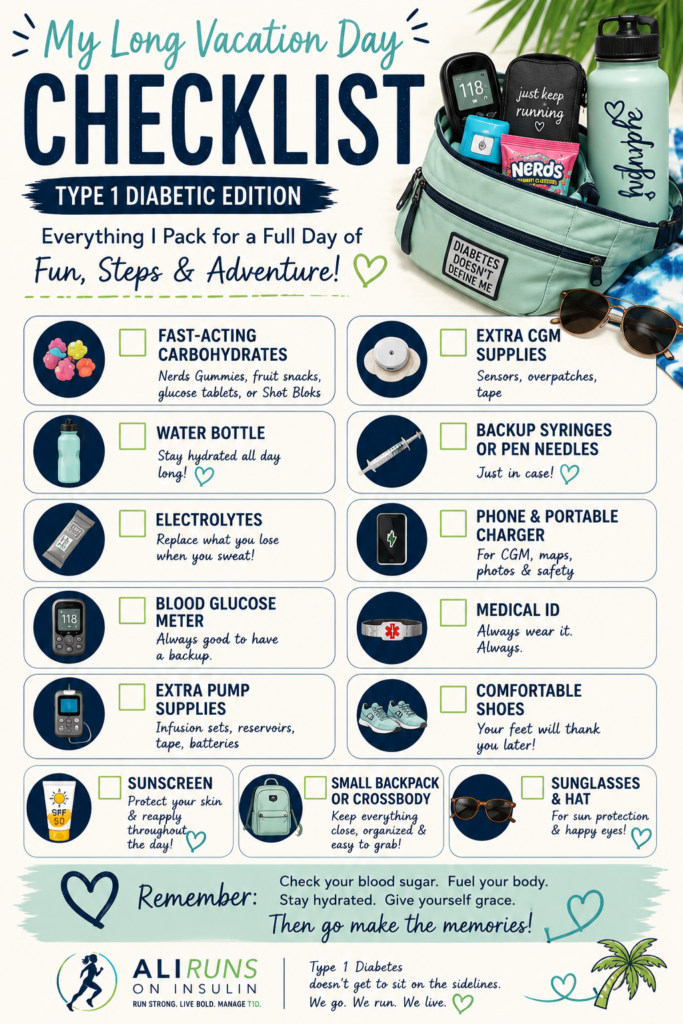
My Long Vacation Day Checklist
Before heading out for a full day of exploring, I make sure I have:
☐ Fast-acting carbohydrates
☐ Water bottle
☐ Electrolytes
☐ Blood glucose meter
☐ Extra pump supplies
☐ Extra CGM supplies
☐ Backup syringes or pen needles
☐ Phone and portable charger
☐ Medical ID
☐ Sunscreen
☐ A small backpack or crossbody bag to keep everything within reach